Resources · Cold Chain Automation
Freezer-Rated AMRs for Cold Chain 3PL Operations
What actually makes an autonomous mobile robot "freezer-rated" — and how to evaluate one for chilled, refrigerated, and sub-zero environments.
A freezer-rated autonomous mobile robot (AMR) is an AMR engineered to operate reliably in cold chain environments — including chilled, refrigerated, and sub-zero freezer zones. For cold chain 3PLs, freezer-rated AMRs can support material movement across facilities that handle frozen food, pharmaceuticals, specialty chemicals, biologics, and other temperature-sensitive products.
Unlike standard warehouse AMRs, freezer-rated AMRs are built to withstand the operating conditions common in refrigerated and frozen logistics facilities. SCxChange Hub is independent and vendor-neutral. This guide explains what those conditions are, what design requirements actually matter, and the questions to ask before you assume an AMR is ready for freezer duty.
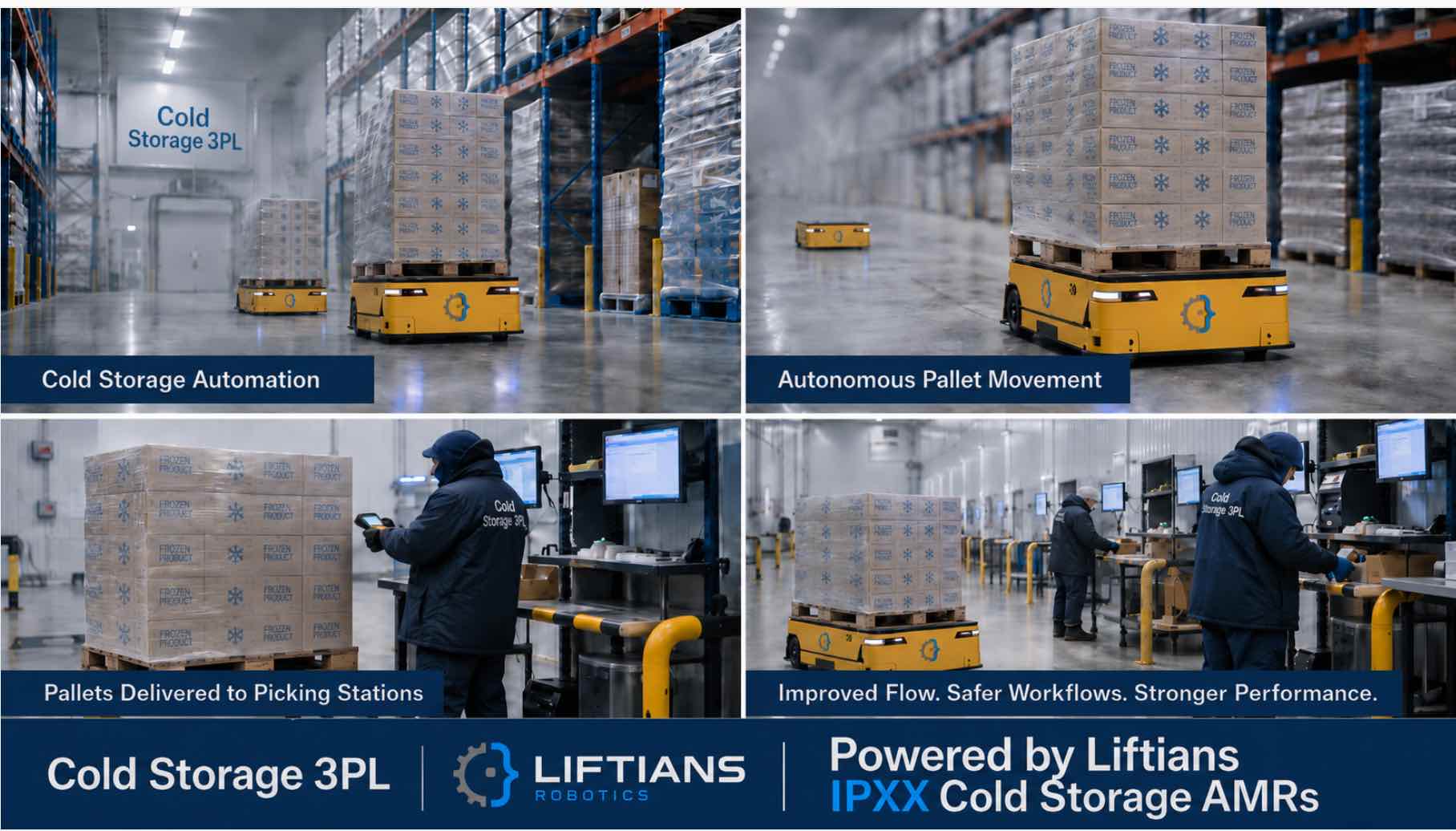
The Conditions a Freezer-Rated AMR Must Withstand
Cold storage and freezer facilities subject equipment to stresses that standard warehouse AMRs were never designed for.
Low temperatures
Sustained sub-zero operation drains standard batteries, stiffens lubricants, and can crack components not rated for the cold.
Condensation & frost
Moisture forms on and inside equipment as robots move between temperature zones, threatening electronics and sensors.
Moisture & washdown
Sanitation spray and washdown procedures expose enclosures to water that can penetrate poorly sealed equipment.
Slick & icy floors
Wet, icy, or frosted floors reduce traction and demand navigation and braking tuned for low-grip surfaces.
Thermal shock
Repeatedly crossing ambient, refrigerated, and freezer zones stresses materials and accelerates condensation.
Brittleness & degradation
Plastics, cabling, and seals not specified for the cold become brittle and fail over freezer duty cycles.
Key Design Requirements
Surviving freezer duty cycles takes purpose-built hardware — not a standard AMR with a heavier coat of paint.
Low-temperature-rated batteries
Cells and battery management validated to charge and discharge in sub-zero conditions without capacity collapse.
Sealed electronics
Enclosed, gasketed electronics that keep condensation, frost, and washdown moisture away from internal boards.
Cold-tolerant sensors
LiDAR, cameras, and safety scanners that stay accurate despite fogging, frost, and temperature swings.
Specialized cabling
Wiring and connectors rated to stay flexible and intact at low temperatures instead of cracking.
Low-temperature lubricants
Greases and lubricants formulated to keep drivetrains and moving parts operating smoothly in the cold.
Cold-rated materials & traction
Housings and wheels that resist brittleness and maintain grip on wet, icy, or condensation-exposed floors.
Ingress Protection (IP) Ratings Explained
IP ratings indicate how well an AMR's enclosure protects internal components from dust and water. In cold storage this matters because moisture enters equipment through condensation, frost buildup, sanitation spray, or washdown.
| Rating | Dust protection | Water protection | Why it matters in cold chain |
|---|---|---|---|
| IP56 | Protected against dust ingress (limited) | Protected against powerful water jets | Baseline protection for sanitation spray and splash; dust-protected but not fully dust-tight. |
| IP65 | Dust-tight | Protected against water jets | Dust-tight enclosure suited to washdown spray — a common target for freezer-duty equipment. |
| IP67 | Dust-tight | Protected against temporary immersion | Highest protection of the three — withstands heavy moisture, frost melt, and brief immersion. |
Important: A higher IP rating can matter, but IP rating alone does not make an AMR freezer-rated. Dust and water protection say nothing about whether the batteries, lubricants, sensors, and materials can survive sustained sub-zero operation.
What a True Freezer-Rated AMR Should Specify
Beyond an IP number, ask vendors to document each of these before you call an AMR freezer-rated.
1. Validated operating temperature range
A specified low-temperature range the AMR is tested and warranted to run in — not just an IP number.
2. Runtime at low temperatures
Real battery runtime in the cold, where capacity is lower than at ambient, so you can plan duty cycles.
3. Charging strategy
How and where the robot charges — in-freezer, in a warm-up zone, or via swap — without damaging cold batteries.
4. Condensation management
A defined approach to handling frost and condensation as the robot transitions between zones.
5. Zone transition capability
The ability to move safely between ambient, refrigerated, and freezer zones throughout a shift.
Cold Chain Temperature Zones
A freezer-rated AMR may need to move across several of these zones in a single shift.
| Zone | Typical temperature | Notes |
|---|---|---|
| Ambient / dry | ≈ 50–75°F (10–24°C) | Receiving, staging, and dry-goods areas where standard AMRs operate. |
| Chilled / refrigerated | ≈ 33–41°F (0–5°C) | Produce, dairy, and many pharma products — cold but above freezing. |
| Frozen | ≈ 0 to -10°F (-18 to -23°C) | Frozen food and many biologics; the core freezer-rated AMR use case. |
| Deep / blast freeze | ≈ -20°F (-29°C) and below | The most demanding storage — only purpose-built equipment survives long term. |
Temperature ranges are typical industry references and vary by product, region, and facility.
Standard Warehouse AMR vs. Freezer-Rated AMR
| Factor | Standard Warehouse AMR | Freezer-Rated AMR |
|---|---|---|
| Operating temperature | Designed for ambient warehouse conditions; performance and battery life drop sharply in the cold. | Validated to a specified low-temperature range, including refrigerated and sub-zero freezer zones. |
| Battery | Standard cells lose capacity and may fail to charge reliably in sub-zero conditions. | Low-temperature-rated cells and battery management built for cold charge/discharge cycles. |
| Electronics & enclosure | Typically lower ingress protection; vulnerable to condensation and washdown moisture. | Sealed electronics with higher IP ratings (e.g. IP56/IP65/IP67) to resist moisture and frost. |
| Sensors | Can fog, frost, or drift when exposed to cold and temperature swings. | Cold-tolerant sensing tuned to stay accurate through condensation and thermal change. |
| Materials & lubricants | Plastics, cabling, and greases may become brittle or stiff in the cold. | Cold-rated materials, cabling, and low-temperature lubricants resist brittleness and stiffening. |
| Traction & navigation | Tuned for dry, high-grip floors. | Navigation and traction handling for wet, icy, or condensation-exposed floors. |
| Zone transitions | Not designed to repeatedly cross ambient, refrigerated, and freezer boundaries. | Built to transition between temperature zones while managing condensation and thermal shock. |
Where Freezer-Rated AMRs Fit
Moving pallets between receiving, storage, and shipping
Transporting totes and cases to and from pick zones
Hauling carts and racks across temperature zones
Replenishing and staging frozen and refrigerated inventory
Carrying picked orders from freezer to packing and shipping
Reducing worker time and exposure inside freezer areas
The Business Value for Cold Chain 3PLs
In a cold chain 3PL environment, the value isn't just automation — it's deploying automation that can survive freezer duty cycles, maintain uptime, protect temperature-sensitive inventory, and operate safely in one of the most demanding warehouse environments.
- •Reduce manual travel and walking inside harsh freezer zones
- •Improve labor productivity on repetitive transport tasks
- •Increase throughput across receiving, storage, picking, and shipping
- •Limit worker exposure to sub-zero conditions and improve safety
- •Protect temperature-sensitive inventory with consistent, reliable movement
- •Maintain uptime through freezer duty cycles, not just short bursts
Frequently Asked Questions
Common questions about freezer-rated AMRs for cold chain 3PL operations.
What is a freezer-rated AMR?
A freezer-rated autonomous mobile robot (AMR) is an AMR engineered to operate reliably in cold chain environments, including chilled, refrigerated, and sub-zero freezer zones. It uses low-temperature-rated batteries, sealed electronics, cold-tolerant sensors, specialized cabling, low-temperature lubricants, and cold-rated materials so it can survive sustained freezer duty cycles that would degrade a standard warehouse AMR.
Does an IP65 or IP67 rating mean an AMR is freezer-rated?
No. An ingress protection (IP) rating such as IP56, IP65, or IP67 only describes how well the enclosure resists dust and water. It says nothing about whether the batteries, lubricants, sensors, and materials can withstand sustained sub-zero operation. A true freezer-rated AMR should also specify a validated operating temperature range, runtime at low temperatures, a charging strategy, condensation management, and the ability to transition between temperature zones.
How is a freezer-rated AMR different from a standard warehouse AMR?
Standard warehouse AMRs are designed for ambient conditions and lose battery capacity and performance in the cold. Freezer-rated AMRs use low-temperature batteries, higher-IP sealed electronics, cold-tolerant sensors, cold-rated materials and lubricants, and navigation tuned for wet or icy floors, and they are built to transition between ambient, refrigerated, and freezer zones while managing condensation and thermal shock.
What temperatures do freezer-rated AMRs operate in?
Freezer-rated AMRs are built for cold chain temperature zones ranging from chilled and refrigerated areas around 33–41°F (0–5°C) down to frozen zones near 0 to -10°F (-18 to -23°C), and in some cases deep or blast freeze environments at -20°F (-29°C) and below. The exact validated range depends on the specific robot, so it should be confirmed with the vendor.
Why do cold chain 3PLs use freezer-rated AMRs?
Cold chain 3PLs use freezer-rated AMRs to reduce manual travel inside harsh freezer zones, improve labor productivity on repetitive transport tasks, increase throughput across receiving, storage, picking, and shipping, limit worker exposure to sub-zero conditions, and protect temperature-sensitive inventory with consistent, reliable movement while maintaining uptime through full freezer duty cycles.
Evaluating AMRs for a Cold Chain Operation?
SCxChange Hub provides independent guidance on AMR selection — no vendor commissions, no preferred platforms. We help you figure out which robots can actually survive freezer duty and make sense for your volume, SKU profile, and facility.
Talk to an independent supply chain expert
Independent, vendor-neutral advice. No pressure — we respond within 2 business days.
Related Resources
Also explore these related resources from SCxChange Hub