Solutions/Buyer Guide

Meet-Me & Follow-Me Person-to-Goods Picking

Compare follow-me robotics, meet-me picking robots, and Pick-to-Light workflows while keeping people responsible for item selection.

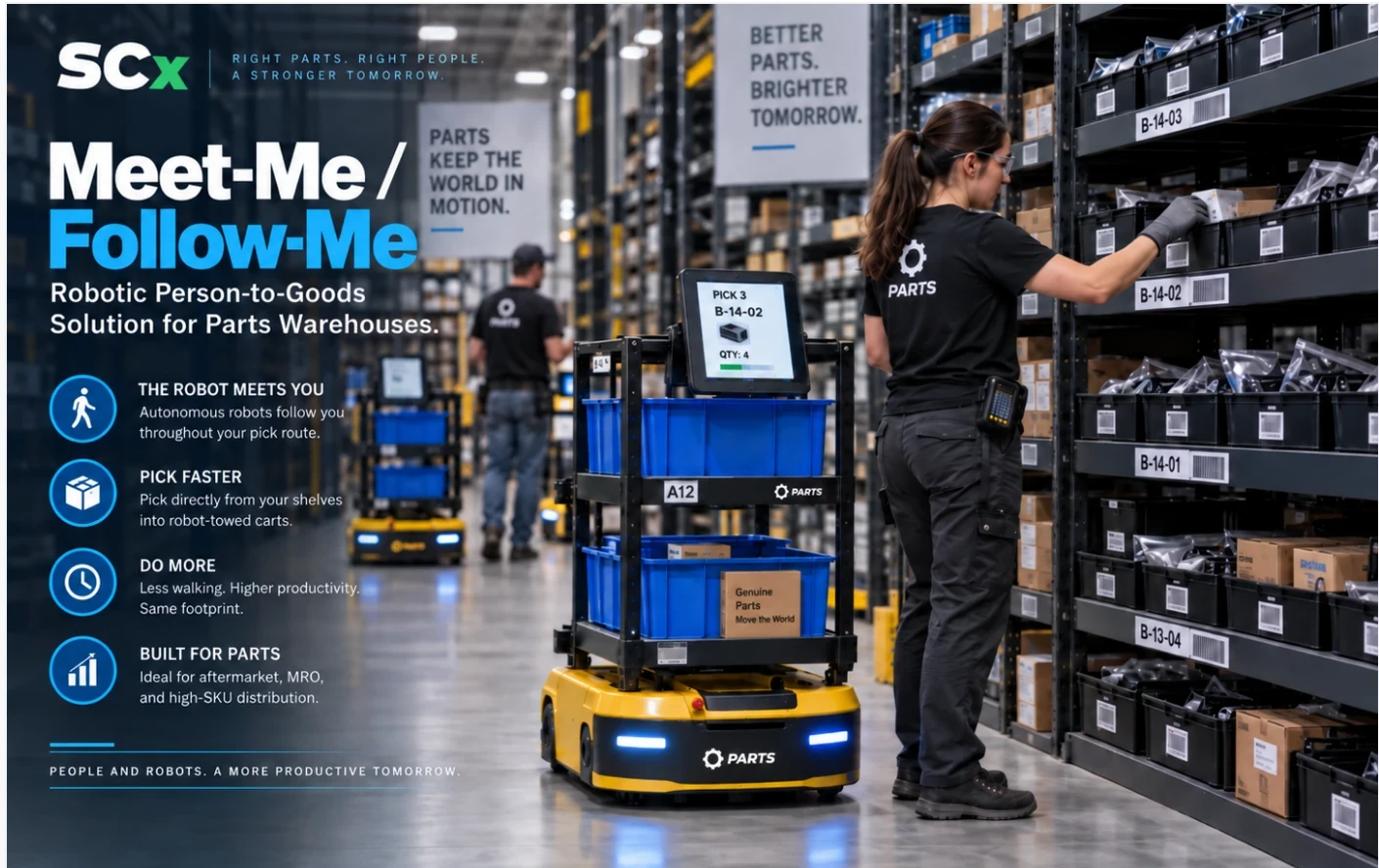
Meet-Me / Follow-Me robotic Person-to-Goods picking: an associate picks parts from warehouse shelves into blue totes on a mobile robot.
Meet-Me / Follow-Me Person-to-Goods picking for parts warehouses. Associates pick from existing shelves while mobile robots transport order totes.Select the image to view it full size.

Technology Overview

Person-to-Goods (P2G) solutions use software and mobile robots to make conventional picking more efficient without moving inventory into a fixed Goods-to-Person system. The associate still travels within the storage area and selects the item, while the robot carries orders, directs work, or meets the associate at an optimized location.

Common approaches include meet-me, follow-me, and Pick-to-Light. In a meet-me workflow, software coordinates associates and robots so they converge at planned pick locations or zones. In a follow-me workflow, a robot accompanies an associate through a pick path and transports completed orders or containers. Pick-to-Light uses illuminated location displays to direct associates to the correct pick face and quantity. The best choice—or combination of approaches—depends on order profile, travel patterns, congestion, zone design, and the level of orchestration available from the WMS or execution layer.

Meet-Me vs Follow-Me Picking Robots

Both approaches are forms of robotic person-to-goods (P2G) picking: inventory stays on the shelves and people select the items. The difference is how the robot and picker move. Neither approach automatically eliminates walking, and both need to be tested against your order profile.

Meet-Me picking

Software coordinates independent robot and associate movements so they meet at a pick location or within a zone. A picker may work with successive robots instead of accompanying one cart through an entire order.

Evaluate: handoff waiting time, pick density, zone balancing, robot availability, and what happens when a picker or robot arrives late.

Follow-Me robotics

A robot accompanies the associate along a picking route and carries order totes or a cart. This can reduce manual cart handling, but the associate still travels to the required pick faces.

Evaluate: route length, tote capacity, aisle clearance, safe following behavior, order drop-off, and recovery when the robot loses its operator.

Follow-Me Robotics for Warehouse Picking

Follow-me robotics, also called follow-me picking or robot-assisted cart picking, supports the associate who walks the pick route. The mobile robot follows with totes or containers while the person selects and confirms items. This is different from a meet-me workflow that dispatches robots and people independently to shared pick locations.

Start with the work you want to improve: pushing loaded carts, transporting order containers, or handling tote exchanges. Check the proposed robot’s payload, following distance, obstacle response, operator identification, safe stopping, and recovery after losing its operator. Confirm whether completed orders are delivered autonomously or require an associate handoff; that behavior varies by solution.

A useful pilot compares full order-cycle time, cart-handling effort, congestion, accuracy, charging time, and support costs against the current process. Follow-me robots do not automatically eliminate walking, and a robot that follows reliably is not necessarily integrated with your WMS. Ask vendors to demonstrate both the physical workflow and the order-confirmation process.

Comparing Locus Robotics, Onward Robotics, and P2G Alternatives

If you are researching Locus Robotics alternatives or comparing Onward Robotics with other warehouse picking solutions, start with the operating workflow—not a headline picks-per-hour claim. SCxChange provides independent advisory, not a competing robot platform. We help you build a shortlist and evaluate proposals against the same requirements.

  • Locus Robotics: its LocusONE materials describe coordination of people, robots, and orders, including system-directed labor. Ask which robot and workflow are included in your proposal, how associates are directed between tasks, and how workload and exceptions are handled. Do not assume every Locus offering uses the same picking method.
  • Onward Robotics: its Lumabot materials describe the Meet Me® solution, with people and robots moving independently under Pyxis orchestration. Ask how wearable instructions, robot arrivals, tote allocation, and your WMS transactions are coordinated.
  • Other P2G approaches: compare follow-me robots, robot-assisted carts, and light-directed picking where appropriate. Verify the actual dispatch method; a mobile robot or illuminated tote alone does not establish a meet-me workflow.

Vendor descriptions are based on public materials reviewed September 27, 2026, not independent performance tests. Products and capabilities change. Meet Me® is Onward Robotics’ branded solution; this guide also uses “meet-me” to describe the general coordinated picking workflow. No vendor endorsement or affiliation is implied.

Sources: LocusONE workflow and labor coordination · Onward Lumabot and Meet Me solution.

Person-to-Goods Picking for Parts Warehouses

Aftermarket, MRO, and high-SKU parts operations can combine many small pick faces with slow-moving inventory, irregular items, and look-alike components. Test barcode confirmation, lot or serial capture, tote partitioning, heavy-part handling, replenishment conflicts, and short-pick recovery. Compare complete order-cycle time—not just the time spent at a successful pick.

How to Evaluate Picking Robot ROI

  1. Establish a baseline: lines per labor hour, travel and waiting time, accuracy, overtime, and order cycle time by shift.
  2. Use representative orders: include peak demand, low-density picks, bulky parts, stockouts, and replenishment traffic.
  3. Measure the whole operation: include tote handoffs, packing queues, charging, support labor, and exception recovery.
  4. Compare total costs: equipment or subscription fees, integration, site changes, training, maintenance, and ongoing software charges.
  5. Agree on acceptance criteria: document throughput, accuracy, availability, and recovery targets before committing to a rollout.

A simple payback estimate divides upfront investment by annual net savings after recurring costs. If net savings are zero or negative, that model does not show a positive payback. Validate assumptions with a pilot rather than treating a vendor benchmark as a forecast.
Build an Independent Meet-Me / Follow-Me Shortlist

Bring your order profile, aisle layout, labor baseline, and WMS requirements. We can help define a practical evaluation of P2G workflows and vendor proposals.

Discuss your person-to-goods picking requirements

Related: Goods-to-Person AMR guidance · Warehouse automation resources

Best-Fit Workflows

Meet-Me Picking

Robots and associates are dispatched independently to coordinated locations, reducing the time a picker spends waiting for or transporting an order container.

Follow-Me Picking

A mobile robot accompanies the associate through a pick path, carrying totes or cartons and reducing pushing, pulling, and return travel.

Pick-to-Light

Illuminated displays direct associates to the correct storage location and quantity, supporting fast, visually guided picking in dense or high-velocity zones.

Zone-Based Fulfillment

Orders move between defined picking zones while associates remain close to the inventory areas they know best.

Brownfield Warehouse Upgrades

Facilities add flexible automation to existing shelving and picking processes without installing a dense fixed storage structure.

Operational Advantages

Reduced Nonproductive Travel

Robots can handle order transport and selected travel segments so associates spend a larger share of the shift picking.

Flexible Deployment

Mobile systems can often work with existing shelving and evolve as pick zones, order profiles, or facility layouts change.

Improved Ergonomics

Removing manual cart movement can reduce pushing, pulling, and the physical effort required to move completed orders.

Incremental Scalability

Operators may be able to add robots, work areas, or shifts without committing to a fixed automation structure.

Limitations & Risks

People Still Travel

P2G reduces travel rather than eliminating it; poor slotting or large pick areas can continue to constrain productivity.

Congestion and Interference

Robot traffic, replenishment activity, and pedestrian movement must be modeled together to avoid blocked aisles and waiting.

Software Orchestration

Meet-me performance depends on timely task assignment, location accuracy, and coordination among the WMS, execution software, robots, and associates.

Workflow Discipline

Exceptions, short picks, damaged inventory, and priority orders need clear handling rules or the expected productivity gains can erode.

Market Representatives

Person-to-Goods offerings vary in how they coordinate people, robots, pick instructions, order containers, and warehouse software. Buyers should compare the proposed operating method—not only robot specifications—and validate it with their own order and travel data.

Notable examples to research:

  • Onward Robotics collaborative person-to-goods picking
  • Numina Group warehouse picking and automation solutions
  • Locus Robotics collaborative warehouse picking

Meet-me and follow-me are distinct operating approaches. Validate each vendor's current workflow capabilities, software responsibilities, regional support, and integration scope.

Vendor mentions are examples to research, not rankings or endorsements; capabilities and availability should be verified directly during selection.

Common Questions

How should I compare Locus Robotics and Onward Robotics?

Compare the proposed workflows using the same order data, layout, WMS requirements, and labor baseline. LocusONE describes coordination of people, robots, and orders; Onward describes independent picker and Lumabot movement within its Meet Me solution. Verify the exact product configuration, integration scope, total cost, and pilot acceptance criteria rather than assuming equivalent capabilities.

What is follow-me robotics in warehouse picking?

Follow-me robotics uses a mobile robot that accompanies a warehouse associate along a pick route and carries order totes or containers. The associate still selects items from shelves; the robot assists with load transport. It differs from meet-me picking, where robots and associates travel independently to coordinated pick locations. Evaluate following behavior, aisle clearance, payload, safe stopping, and recovery when the robot loses its operator.

When should a warehouse consider follow-me robots?

Consider follow-me robots when associates spend significant effort pushing loaded carts and orders can be collected along practical pick routes. Test representative orders, aisle congestion, tote handoffs, charging, and WMS integration. The robot may reduce cart handling without reducing the associate's walking, so measure complete order-cycle time and total operating cost before assuming an ROI.

Does SCxChange manufacture picking robots?

No. SCxChange provides independent supply chain advisory, including workflow definition, vendor shortlisting, and implementation oversight. We help buyers evaluate person-to-goods solutions rather than sell a proprietary robot platform.

What is the difference between meet-me, follow-me, and Pick-to-Light picking?

In meet-me picking, software dispatches robots and associates independently so they converge at planned locations. In follow-me picking, a robot accompanies an associate through a pick path and carries the order container. Pick-to-Light uses illuminated displays at storage locations to direct the associate to the correct item and quantity.

Is Person-to-Goods the same as Goods-to-Person?

No. Person-to-Goods keeps inventory in the storage area and improves how associates travel and transport orders. Goods-to-Person brings inventory to a stationary or limited-travel workstation using a storage and retrieval system.

Can Person-to-Goods work with an existing WMS?

Often, but the integration depth varies. Buyers should verify task release, pick confirmation, exception handling, priority changes, inventory updates, and reporting against the exact WMS and solution architecture.

Buyer Evaluation Criteria

Workflow Technology Fit

Determine whether the operation benefits most from meet-me orchestration, a follow-me robot, Pick-to-Light direction, or a combination across different zones.

Order and SKU Profile

Model lines per order, units per line, SKU velocity, item dimensions, and order-container requirements against each workflow.

Integration Depth

Verify how tasks, inventory exceptions, confirmations, priorities, and labor assignments pass between the solution and existing systems.

Fleet and Labor Modeling

Evaluate robot-to-associate ratios, charging strategy, peak demand, aisle congestion, and the effect of replenishment activity.

Implementation Questions to Ask

  • 1.

    Which travel, search, and confirmation steps are eliminated by the proposed meet-me, follow-me, or Pick-to-Light workflow?

  • 2.

    How does the system handle short picks, substitutions, damaged goods, and priority-order interruptions?

  • 3.

    What robot-to-associate ratio is expected by shift, zone, and peak order profile?

  • 4.

    How are task status, pick confirmation, inventory exceptions, and labor activity exchanged with our WMS or WES?

Need Independent Advice?

We help operations evaluate the right automation category and vendors without bias. Avoid costly mistakes by benchmarking against real-world data.