Transportation Value Chain
How multi-site enterprises unify YMS, TMS, dock scheduling, carrier connectivity, and real-time visibility into a single transportation platform — from gate to delivery.
For most enterprises, transportation is managed in fragments. The yard team tracks trailers one way, the dock team manages appointments another, the TMS handles routing, and carrier visibility lives in a separate portal — if it exists at all. The result is a series of disconnected handoffs that inflate cost, create blind spots, and make exception management reactive instead of proactive.
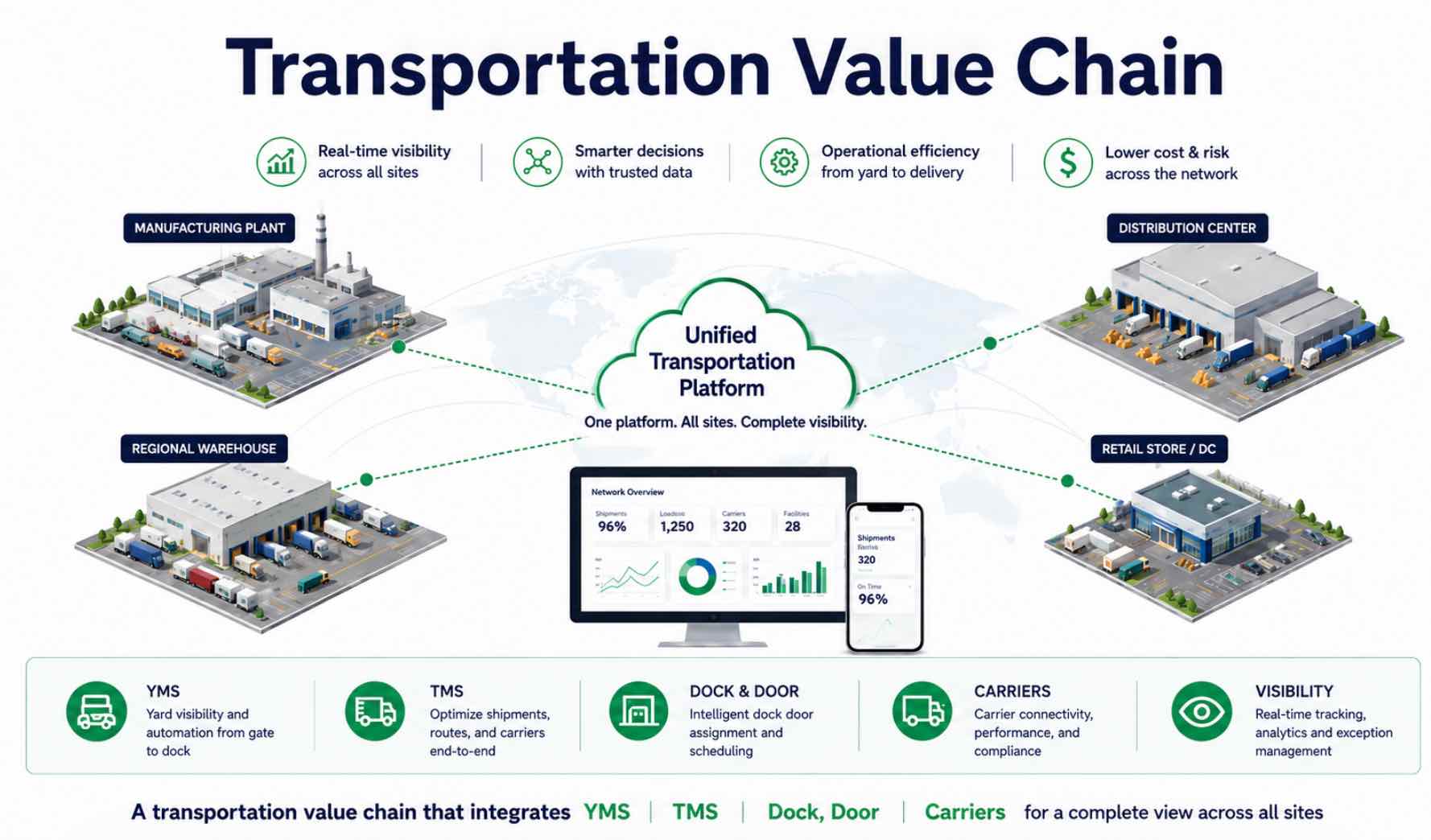
The transportation value chain connects these functions into a unified platform — one that gives every site, every team, and every level of leadership the same real-time view of freight movement across the network. For multi-site enterprises managing dozens of facilities and hundreds of carriers, this integration isn't a nice-to-have. It's the difference between running a transportation network and just reacting to it.
Where Transportation Spend Management Fits
Transportation Spend Management puts the cost side of those handoffs in view. TMS rate shopping and contracts inform carrier selection; freight audit and invoice matching help teams compare billed charges with shipment records. Yard dwell time and dock appointments provide context for detention charges, while carrier performance and freight spend analytics help procurement and operations review costs by lane, carrier, and site. These financial questions belong alongside execution and visibility, not in place of them.
15–25%
Typical freight cost reduction from TMS-driven optimization
30–50%
Reduction in dock detention charges with appointment management
2–4 hrs
Average time saved per day in manual carrier communications
99%+
Shipment visibility achievable with modern connectivity platforms
Why Multi-Site Changes Everything
A single-site transportation problem is manageable with spreadsheets and phone calls. Once you're operating across manufacturing plants, regional warehouses, distribution centers, and retail locations simultaneously, the coordination complexity multiplies faster than headcount can absorb. A unified transportation platform — one that aggregates YMS, TMS, dock, carrier, and visibility data across all sites — is the only scalable answer.
Solutions Across the Transportation Value Chain
Transportation Spend Management connects freight sourcing, shipment execution, and financial controls. It complements YMS, TMS, dock scheduling, and visibility by helping teams understand contracted rates, actual charges, and the operational causes of avoidable costs. Evaluate software and managed-service options against your network and finance requirements.
- ✓Freight spend analysis by carrier, lane, mode, and business unit
- ✓Carrier sourcing, rate benchmarking, and contract review
- ✓Freight audit, invoice validation, and payment coordination
- ✓Detention, accessorial, and duplicate-charge review
- ✓Cost allocation and reconciliation with shipment records
- ✓Savings measurement alongside service-level and carrier performance
A Yard Management System provides real-time visibility into every truck, trailer, and gate event across your facility. For multi-site enterprises, YMS eliminates the blind spot between the carrier network and the dock door — tracking trailer location, dwell time, driver check-in, and gate-to-dock movement without relying on manual radio calls or spreadsheets.
- ✓Automated gate-in / gate-out event capture
- ✓Trailer inventory by status: loaded, empty, in-transit, dropped
- ✓Yard jockey task management and spotting queue
- ✓Real-time dock door association and trailer assignment
- ✓Dwell time reporting and detention cost tracking
- ✓Multi-yard visibility from a single dashboard
A Transportation Management System (TMS) supports how freight moves end-to-end — from load planning and carrier selection through execution, tracking, and freight audit. For Transportation Spend Management, rate shopping, invoice matching, and freight spend analytics help procurement and finance understand what was contracted, shipped, and billed. Teams can use that information alongside operational data to investigate cost and compliance gaps.
- ✓Load planning and optimization across modes (LTL, FTL, intermodal)
- ✓Carrier rate shopping and contract management
- ✓Tender management and carrier acceptance tracking
- ✓Automated freight audit and invoice matching
- ✓Shipment execution from origin to delivery
- ✓Network-wide freight spend analytics and cost allocation
Dock scheduling coordinates the physical meeting point between transportation and warehouse operations. Without intelligent dock management, loading docks become bottlenecks — carriers arrive outside their windows, warehouse labor is idle or overwhelmed, and detention charges accumulate. A dock scheduling platform brings structure to appointment booking, door assignment, and inbound/outbound flow management.
- ✓Carrier self-service appointment booking portal
- ✓Intelligent dock door assignment by product type, carrier, or priority
- ✓Load type rules (live load vs. drop-and-hook) per door
- ✓Real-time dock status board visible to yard and warehouse teams
- ✓Automated appointment confirmation and reminder notifications
- ✓Compliance scoring for carrier on-time arrival performance
Carrier performance directly affects your customer service levels — but most enterprises lack the systems to measure it systematically. Carrier connectivity means more than tracking a shipment; it means having structured data on tender acceptance rates, on-time pickup, transit time adherence, and claims history across your entire carrier network, standardized enough to act on.
- ✓EDI and API integration with carrier networks
- ✓Tender acceptance rate and response time tracking
- ✓On-time pickup and delivery performance scoring
- ✓Claims management and exception workflow
- ✓Carrier scorecards updated on a recurring cadence
- ✓Compliance documentation and carrier onboarding management
Transportation visibility closes the information gap between when a shipment leaves and when it arrives. For multi-site enterprises, real-time visibility means knowing the status of every in-transit load across every site simultaneously — and being alerted to exceptions before they become service failures. Modern visibility platforms aggregate GPS, ELD, and carrier EDI data into a single view accessible to operations, customer service, and leadership.
- ✓In-transit shipment tracking across all carriers and modes
- ✓Predictive ETA with confidence intervals based on live traffic and carrier data
- ✓Exception alerting for late pickups, delays, and missed deliveries
- ✓Customer-facing tracking portals and proactive notifications
- ✓Multi-site shipment dashboard with network-level KPIs
- ✓Historical on-time performance analytics by lane, carrier, and site
Vendor Spotlights
Vendor Spotlight
Kaleris
Kaleris is one of the platforms enterprises evaluate when unifying these layers. Its execution and visibility suite spans yard management, transportation management, dock and gate operations, and real-time shipment visibility — covering the transportation value chain described on this page from a single vendor. As with any platform decision, fit depends on your network, sites, and existing systems; SCxChange Hub can help you evaluate Kaleris alongside the alternatives.
Vendor Spotlight
Tompkins Logistics
Tompkins Logistics describes a managed transportation offering covering provider sourcing and performance management, mode and route optimization, shipment visibility and exception control, and freight audit and payment coordination. These capabilities make it a provider to evaluate for Transportation Spend Management alongside broader transportation operations.
Unlike a software-only evaluation, a managed-service assessment should clarify who owns carrier decisions, execution, invoice review, reporting, and savings measurement. SCxChange can help assess the proposed scope against your network, existing systems, and service requirements.
Discuss Tompkins Logistics and your transportation requirementsSource: Tompkins Logistics — Managed Transportation, reviewed September 27, 2026.
Vendor spotlights are examples for evaluation, not rankings or endorsements. Confirm current capabilities, commercial terms, and integration responsibilities directly during selection.
Integration Is the Strategy
Each layer of the transportation value chain delivers value on its own. But the compounding benefit comes from integration — when YMS event data triggers dock availability updates, when TMS routing decisions account for real-time carrier performance scores, when dock appointment data flows back into shipment execution, and when every exception surfaces in a single visibility dashboard regardless of which site or carrier it involves.
For enterprise procurement and operations teams, this integration changes how transportation decisions get made. Instead of responding to last-minute calls from the dock or chasing carrier ETAs by phone, teams operate from a shared operational picture — with the data to act early, optimize continuously, and hold carriers accountable with evidence.
Evaluating Transportation Technology?
SCxChange Hub helps multi-site enterprises evaluate Transportation Spend Management, YMS, TMS, dock scheduling, and visibility solutions — without vendor bias. Let's talk about your network.
Get in TouchRelated Resources
Also explore these related resources from SCxChange Hub